
SpaceX Launches Massive Starship V3 Rocket on Landmark Test Flight
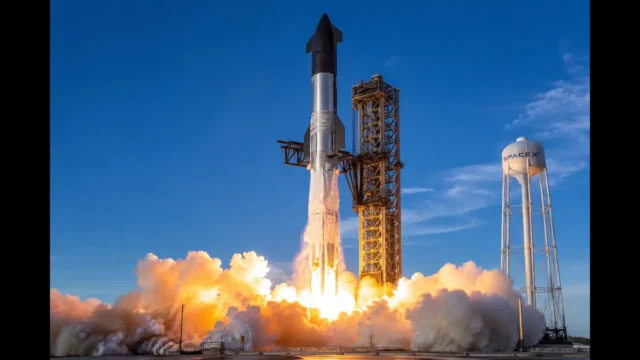
SpaceX has successfully launched its next-generation Starship V3 rocket, marking another major milestone in the company’s ambitious effort to revolutionize space travel. The uncrewed spacecraft lifted off from the company’s Starbase facility in Texas on Friday evening, following a one-day delay caused by a technical issue with launch infrastructure.
The test flight attracted global attention as Starship V3 represents the largest and most powerful rocket ever built. Standing an impressive 124 meters (407 feet) tall, the towering launch vehicle is designed to carry humans and cargo to the Moon, Mars, and beyond.
Delayed Launch Finally Gets Underway
The mission was originally scheduled for Thursday but was postponed after engineers detected a malfunction involving the launch tower systems. After completing safety checks and repairs, SpaceX received approval to proceed with the launch on Friday.
At approximately 5:30 PM local time (22:30 GMT), the giant rocket roared to life, sending millions of pounds of thrust into the ground beneath it. The vehicle ascended smoothly through the atmosphere as spectators gathered nearby and millions watched the livestream around the world.
The successful liftoff was greeted with applause from SpaceX engineers and mission controllers, who have spent years developing the Starship program.
Successful Satellite Deployment in Space
After reaching space, Starship V3 successfully completed one of its primary mission objectives by deploying 20 dummy satellites. The test payloads were designed to simulate future commercial and scientific cargo missions.
The deployment demonstrated Starship’s ability to carry and release multiple payloads during a single mission, an important capability for future satellite launches and deep-space exploration projects.
Following the deployment phase, the spacecraft began preparations for its return journey to Earth.
Engine Challenges During Flight
Although the mission achieved most of its planned objectives, engineers reported that both stages of the rocket experienced engine failures during portions of the flight.
Despite these technical issues, the spacecraft continued operating and maintained enough performance to complete the majority of mission milestones. SpaceX officials viewed the outcome as a significant success because valuable flight data was collected throughout the mission.
Testing programs for large and complex spacecraft often involve identifying weaknesses and improving systems based on real-world flight performance. The information gathered during this mission is expected to help engineers refine future Starship vehicles.
Planned Splashdown Ends with Explosion
Roughly one hour after launch, Starship V3 re-entered Earth’s atmosphere and descended toward a designated splashdown zone in the Indian Ocean.
The spacecraft successfully reached the ocean as planned before exploding shortly after impact. According to mission plans, the destruction of the test vehicle was an expected outcome and allowed engineers to evaluate the spacecraft’s performance throughout every phase of the mission.
The splashdown marked the conclusion of a test flight that covered launch, orbital operations, payload deployment, atmospheric re-entry, and final recovery procedures.
Elon Musk Celebrates Achievement
Following the mission, SpaceX founder and CEO Elon Musk praised the company’s engineers and employees for their efforts.
Posting on social media platform X, Musk congratulated the SpaceX team on what he described as an “epic” first launch and landing of Starship V3.
He highlighted the significance of the achievement for future human space exploration, stating that the mission represented progress toward humanity’s long-term goals in space.
Support from NASA
The successful test flight also received praise from NASA officials. NASA plans to use Starship technology as part of future lunar missions under its Artemis program, making the rocket’s development an important priority for the agency.
NASA Administrator Jared Isaacman congratulated both Musk and the SpaceX team following the mission.
He described the launch as another important step toward returning humans to the Moon and eventually sending astronauts to Mars.
The positive response from NASA reflects growing confidence in Starship’s potential role in future exploration missions.
Largest Rocket Ever Built
Starship V3 is the latest evolution of SpaceX’s fully reusable launch system. At 124 meters tall, the vehicle surpasses every rocket previously constructed in terms of overall size and power.
The rocket is designed to dramatically reduce the cost of space travel through rapid reusability, enabling frequent missions to Earth orbit, the Moon, and eventually Mars.
SpaceX believes Starship could become the backbone of future space transportation, supporting scientific research, commercial operations, satellite deployment, and human settlement beyond Earth.
IPO Plans Generate Investor Excitement
The debut of Starship V3 comes amid growing excitement surrounding SpaceX’s reported plans for a future stock market listing.
Industry analysts believe a potential initial public offering (IPO) could become one of the largest public offerings in financial history due to the company’s enormous valuation and expanding business operations.
Investors are closely monitoring SpaceX’s progress as the company continues to strengthen its position in the aerospace sector.
Beyond Rockets
While SpaceX is best known for its rockets and spacecraft, the company has expanded far beyond launch services. Its Starlink satellite network provides internet connectivity across the globe, while related technology initiatives continue to support communications and space-based infrastructure.
The company’s growing influence across multiple industries has helped establish SpaceX as one of the world’s most closely watched technology and aerospace firms.
Looking Ahead
The successful Starship V3 test flight represents another major step forward in SpaceX’s long-term vision of making humanity a multi-planetary species. While technical challenges remain, the mission demonstrated important capabilities and provided valuable engineering data for future improvements.
As development continues, Starship remains central to plans for lunar exploration, Mars missions, and the next generation of commercial space travel.
With each test flight, SpaceX moves closer to transforming ambitious science-fiction concepts into operational reality.